

How ACT Corporate Broadband with SmartWiFi Is Redefining SME Security with URL Filtering
- 52
- |
- 07 May 2026
- |
- 5 minutes
Small and medium enterprises (SMEs) that help drive India’s digital economy are increasingly exposed to cyber risk. As businesses scale and digitise, their networks become critical not just for operations, but also as primary entry points for attackers. Yet, security often lags behind growth. This gap is significant: according to a recent OECD 2025 SME digitalisation report, 32% of SMEs have already experienced a cyber breach, a figure that has doubled year-on-year. At the same time, many SMEs still operate with minimal protections. An OECD 2026 study on SME cybersecurity readiness shows that 46% of SMEs have either no or only minimal cybersecurity measures in place. The result is a widening vulnerability gap, where smaller businesses are increasingly targeted because they are easier to breach.
This vulnerability is amplified by how modern cyberattacks are executed. Today, most attacks originate from basic, web-based vectors such as phishing emails, malicious links and compromised websites. Research shows that phishing remains the dominant attack method against SMEs, exploiting human behaviour rather than technical weaknesses. The scale of the problem is growing rapidly as AI-driven phishing campaigns are now more convincing and harder to detect. In fact, a 2025 industry report found that 84% of businesses experienced phishing-driven breaches in the past year, underlining how pervasive and effective these attacks have become.
SMEs often become victims of ransomware attacks. 82% of ransomware attacks have historically targeted businesses with fewer than 1,000 employees. In 2025, 40% of SMBs hit by ransomware had to lay off staff within three months, highlighting the operational fallout.
For SMEs, where employees do not have the awareness of evolving cyber threats or are often not given periodic cybersecurity training, the risk of accidental exposure is significantly higher. This means a single click on a malicious URL can lead to ransomware, data theft or complete operational shutdown.
To face looming cyberthreats and be future-ready, businesses are realising the need to strengthen their security strategy at every level, including their connectivity infrastructure. In this regard, URL filtering becomes a crucial measure to reduce cyber threats by controlling employee access to web content.
The SME challenge: growing fast, securing faster
India’s SME sector is expanding rapidly, but digital maturity has not kept pace with this growth. Many businesses operate with fragmented connectivity, limited IT oversight and constrained cybersecurity investment, making them highly susceptible to attacks. As businesses scale, they must manage increasingly complex environments, including rising device density and user traffic, widespread adoption of cloud-based applications and remote access, and the movement of sensitive data across multiple touchpoints. Each of these factors expands the attack surface, increasing the number of potential vulnerabilities that cybercriminals can exploit.
At the same time, attackers are becoming more sophisticated and opportunistic. Email remains the top vector for malware delivery, accounting for 61% of threats, while a significant portion of malicious messages still bypass traditional defences. The financial impact is equally severe. Studies indicate that even a single cyberattack can cost SMEs huge losses, including long-term reputational damage and business disruption. Compounding this risk is the rise of AI-powered threats, now cited as a top cybersecurity concern by 35% of SMEs, reflecting how quickly the threat landscape is evolving.
The challenge, therefore, is no longer just about enabling seamless connectivity. It is also about securing it by design. SMEs must adopt proactive, network-level defences that can prevent threats before they enter the system, ensuring that business growth does not come at the cost of increased cyber risk.
URL filtering: from basic control to strategic defence
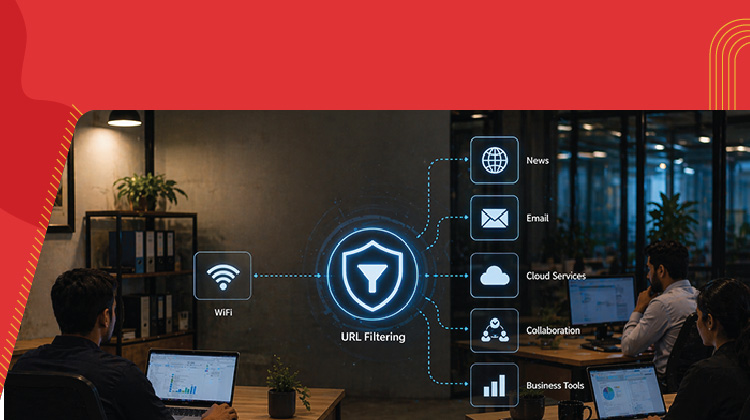
URL filtering is often misunderstood as a simple blocking tool. When this capability is integrated into the network architecture, it becomes a strategic layer of defence that actively protects business environments.
At its core, URL filtering acts as a critical control layer that regulates both inbound and outbound traffic to ensure only safe and relevant web access is permitted. It also blocks malicious sites, phishing attempts and websites unrelated to business in real time, by enforcing policy-based access controls that are tailored to specific roles and user groups within the business setup.
But the real value lies in what it enables beyond security such as operational continuity and productivity optimisation. For example, by preventing malware and ransomware attacks, businesses avoid costly downtime and disruptions. Similarly, when non-essential or risky browsing is restricted, teams tend to stay focused and efficient at work.
ACT Corporate Broadband (CBB) with SmartWiFi - powered by AI: enterprise-grade security built into the fabric of connectivity
Business broadband today goes beyond speed. It is defined by intelligence, performance and built-in security. The fiber-based infrastructure combined with AI-powered Wi-Fi from ACT Enterprise delivers high-speed, reliable connectivity while embedding critical safeguards such as URL filtering directly into the network layer.
Here, URL filtering moves beyond being just a security feature to becoming a strategic enabler. It ensures that as businesses move faster and scale further, their networks remain secure and resilient. Therefore SMEs can benefit from:
A unified, intelligent network for modern SMEs
ACT Corporate Broadband (CBB) with Smart WiFi - powered by AI is purpose-built for growing businesses that need more than just high-speed internet. It integrates connectivity, performance and security into a single, cohesive solution. Unlike traditional setups, where security is layered on as an afterthought, our solution embeds protection directly into the network. As a result, security is an intrinsic part of everyday operations rather than an afterthought.
Enhanced security of the network
Built-in URL filtering acts as a critical first line of defence, automatically blocking malicious, phishing, and non-business websites to significantly reduce exposure to online threats. Instead of reacting to incidents after they occur, the network actively prevents them from entering the system in the first place.
Comprehensive protection without complexity
In addition, ACT CBB extends its security capabilities through features designed for real-world business environments. Secure Guest WiFi isolates visitor traffic from internal systems, preventing unauthorised access to sensitive resources. Enterprise-grade security is reinforced through integrated Endpoint Detection and Response (EDR) and antivirus solutions.
Together, these capabilities enable SMEs to enforce consistent, organisation-wide security policies without having to depend on large IT teams or complex infrastructure. The result is a streamlined yet robust security framework that scales effortlessly with business growth.
Focus on growth and innovation minus the risk
For SMEs, URL filtering translates into a lower risk of cyber incidents, reduced downtime and operational losses, improved employee productivity through safer and more focused internet usage, and stronger customer trust built on secure, reliable digital experiences. Most importantly, it allows businesses to focus on growth and innovation without constantly worrying about vulnerabilities.
Ultimately, protecting your network goes beyond avoiding threats to safeguarding the future of your business.

 Please wait while we redirect you
