

How to setup your co-working space for the best connectivity experience from the get-go
- 110
- |
- 06 July 2026
- |
- 5 minutes
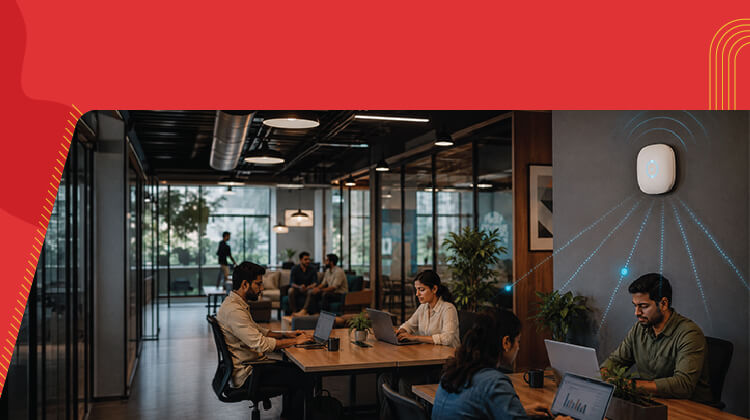
Future-Proofing Co-Working Hubs: Using Managed Connectivity to Minimise Downtime Costs for Members
The professional landscape in India is witnessing a monumental shift. By 2027, the flexible workspace stock across India's seven leading cities is projected to exceed 100 million square feet. This surge is not merely a trend; it is a strategic pivot as entrepreneurs and SMBs increasingly abandon traditional long-term leases in favour of modern, flexible co-working spaces.
The primary driver is a significantly lower Total Cost of Ownership (TCO) and the agility to scale without heavy capital expenditure. However, for a co-working space provider, the foundation of this value proposition is a robust network infrastructure that delivers seamless enterprise connectivity from the very first day.
For operators in tech-heavy hubs like Bengaluru, while demand is tangible, setting up a high-density business network presents complex challenges that can often hassle first-time providers. To transition from a vacant floor to a high-performing business hub, business connectivity must be engineered as a core pillar of the infrastructure, not a secondary utility.
The connectivity crisis
In the early days of the flex-space movement, a standard, high-speed internet solution might have sufficed. Today, the expectations of SMBs and enterprises have evolved. They now view connectivity as a business-critical utility. Setting up a co-working space involves navigating what experts call the 'Reliability Crisis'. A co-working environment must handle hundreds of concurrent sessions, ranging from high-definition video conferencing to secure VPN tunnels for remote server access.
When a network buckles under peak load, the fallout is immediate. Global research suggests that even for smaller firms, real costs (including labour, revenue loss, recovery costs, reputational harm) of network downtime can vary from $2,000 to $10,000 every hour. For a co-working operator, this translates directly into high churn rates; nearly 25% of users have cited poor infrastructure as a reason for cancelling memberships. In a competitive market, providing a stable business network is your strongest retention tool.
Challenge 1: The high-density device dilemma
The modern employee carries two to three connected devices: a laptop, a smartphone, and often a tablet or smartwatch. So, in a space designed for 200 people, enterprise connectivity is actually supporting 600+ active connections. Traditional routers are not built for this kind of device density. They struggle with co-channel interference (where signals overlap and cancel each other out) leading to the dreaded 'connected but no internet' status that frustrates members. Without enterprise-grade hardware, the high-speed promise becomes a bottleneck.
Challenge 2: Bandwidth asymmetry and latency
A basic connectivity solution is asymmetric, offering high download speeds but sluggish upload speeds. For a tech-based business uploading large code repositories or a marketing agency sending 4K video files to clients, this asymmetry becomes a major hindrance. Furthermore, high latency can ruin VoIP calls and virtual meetings, which are the lifeblood of modern SME operations. Operators must ensure their co-working network provides the throughput required for these intensive bi-directional data transfers.
How ACT Enterprise meets these challenges
Choosing the right ISP is the most critical decision for a co-working operator that will determine member experience. ACT Enterprise provides a suite of connectivity solutions specifically engineered to solve the Day 1 hurdles of workspace management through technical superiority and proactive support.
Proactive infrastructure with Managed SmartWiFi
To avoid the constant "Wi-Fi is slow" complaints, operators need an intelligent system. ACT Managed SmartWiFi uses AI-powered access points that proactively manage the device environment.
- Seamless roaming: Members can move from a private glass-walled office to a communal café zone or a meeting room without their video call dropping. The system hands off the device to the nearest, strongest signal point automatically.
- AI-driven load balancing: The system intelligently distributes devices across different frequencies. If one area of the lounge becomes crowded with too many devices, the network automatically shifts the load to underutilised access points to maintain consistent network experience.
Scalability via Internet Leased Line (ILL)
For providers catering to larger enterprise teams, an ILL is non-negotiable. Unlike shared broadband, an ILL offers a dedicated pipe to your building, ensuring bandwidth is never diluted by external traffic.
- Symmetric speeds: Ensure that tenants can upload as fast as they can download, facilitating seamless cloud collaboration.
- Service Level Agreements (SLAs): ACT Enterprise provides ironclad SLAs for uptime and latency. This allows businesses to guarantee a guaranteed level of performance to their premium members, which serves as a significant selling point during the sales process.
Zonal security and compliance
Under modern data protection regulations, such as India's Digital Personal Data Protection Act (DPDP), the onus of data security often falls on the infrastructure provider. A "flat" network where everyone is on the same subnet is a security nightmare.
- Network segmentation: ACT's solutions allow businesses to create logically isolated virtual networks (VLANs). This ensures that a sensitive document sent to a printer by one company cannot be intercepted by another.
- Secure guest access: Helps manage temporary visitors with secure, time-bound credentials that keep the main business network isolated. This level of security is a prerequisite for enterprises handling sensitive financial, legal, strategic business data.
Driving down TCO for operators
The biggest advantage of partnering with ACT Enterprise from the get-go is the reduction in operational costs for co-working spaces. Deploying a Managed SmartWiFi solution eliminates the need for an expensive, on-site IT team to manually troubleshoot daily signal-dead zones.
The centralised dashboard allows facility managers to monitor the health of the entire enterprise network across multiple floors or even multiple cities from a single screen. This low-touch infrastructure means businesses can focus their resources on community building and member experience rather than technical troubleshooting. When the infrastructure works silently in the background, operational efficiency improves, leading to a much healthier bottom line and a lower TCO over the long term.
In the competitive landscape of metros as well as rapidly growing Tier II and Tier III cities, the aesthetics of a co-working space might get a member through the door, but the reliability and range of experience of the co-working network is what keeps them there. Modern professionals running small businesses require more than just a desk. They are on the lookout for an environment where their digital tools can work without friction while being easy on budget.
By integrating ACT's solutions right from the design phase, co-working spaces can ensure that their facility is equipped to handle the demands of tomorrow's digital-first workforce. Don't let connectivity be an afterthought; ensure it becomes your competitive edge.
| Ready to build a workspace that never goes offline? Schedule a consultation with our experts today! |

 Please wait while we redirect you
