Why Conventional Internet Connections are Becoming a Business Risk for Most SMBs - ACT
Monday, Sep 21, 2026 · 4 minutes



Whenever an SMB plans to buy a connectivity plan or solution, they ask the same question: what is the cheapest connection that gets the job done, a reasonable starting point, except that the definition of "the job" has changed far faster than connectivity budgets have. With a plan built for email and browsing now expected to carry billing, cloud applications, digital payments, and customer WiFi all at once. The moment that plan fails, the savings it delivered on paper turn into a cost the business never accounted for, and over 35% of Indian SMEs already report facing internet connectivity issues, a structural gap rather than an edge case.
Connectivity decisions in most SMB setups are made once, early in the business's life, and rarely revisited, largely because the plan appears to work until the day it does not, by which point it has quietly become load-bearing infrastructure that the business did not account for. That pattern made sense when office internet access was a support function rather than the layer every sales terminal, cloud dashboard, and customer touchpoint now depends on, and rethinking it means treating connectivity less like a utility bill and more like a business continuity investment.
The economics do not favour the cheaper plan once a real outage is factored in, because a ₹1000 to ₹2,000 saving on a monthly office internet bill can be wiped out several times over by a single afternoon of missed orders, stalled digital payments, and staff sitting idle while systems are unreachable. High-impact IT outages already cost Indian businesses close to $76 million a year, a figure that sits alongside a harder truth about capacity, with Indian MSMEs operating at roughly 18% of large-enterprise productivity against 45 to 70% in OECD economies.
Many SMBs assume they already have a safety net because someone can switch to a mobile hotspot or a second SIM the moment the primary line drops, but that depends on a person noticing the outage in real time and reconfiguring devices while revenue is already being lost, an acceptable stopgap when a slow connection was merely an inconvenience but no longer adequate where payment systems, cloud tools, and customer WiFi need to stay live without a person standing by to catch the failure.
Automated failover removes both the delay and the dependency on a human response, because the moment a primary connection weakens or drops, the system shifts traffic to a secondary line or cellular backup on its own, keeping operations running with no visible interruption. That is the difference between a business that stays operational through an outage and one that stops functioning the instant its single connection does.
Connectivity is increasingly folded into business continuity and resilience planning largely because SMBs allocate only 3 to 7% of revenue to digital infrastructure, which means every rupee spent needs to protect operations rather than simply enable them, pushing SMBs to evaluate providers on resilience, security, and intelligence rather than price per Mbps alone.
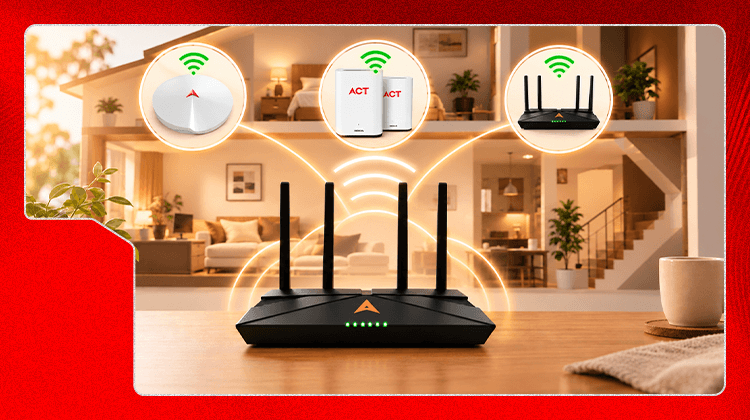
ACT Corporate Broadband with Smart WiFi is built around this need, combining high-speed connectivity with AI-driven network management and built-in redundancy through a managed CPE that connects to multiple ISPs and includes cellular backup via an integrated SIM slot, so if the primary line fails, the system fails over automatically and keeps billing, cloud applications, and customer WiFi running without disruption, while AI-enabled access points continuously optimise performance, giving SMBs enterprise-grade reliability without an in-house IT team.
The lowest-budget internet option is not always the lowest-cost business decision once downtime, lost revenue, and customer experience are factored into the real price of a connection, and SMBs now need connectivity built to protect operations, not just enable them, with automated failover treated as a core requirement. ACT Corporate Broadband with Smart WiFi helps SMBs move from basic internet access to intelligent, resilient connectivity that is made for your business.

Lead has been submitted successfully.
 Please wait while we redirect you
One of our representatives will reach out to you shortly
One of our representatives will reach out to your shortly
Please wait while we redirect you

Please enter your registered phone number to proceed
Please enter correct OTP to proceed

Dear customer you are successfully subscribed
Please wait while we redirect you
Your ACT Shield subscription has been successfully deactivated
Please wait while we redirect you
Dear user, Your account doesn't have an active subscription
Please wait while we redirect you
Dear customer Entertainment pack is already activated.
Please wait while we redirect you