Wifi Extender vs Mesh System vs New Router: What Actually Fixes Patchy Coverage
Wednesday, Sep 23, 2026 · 2 minutes


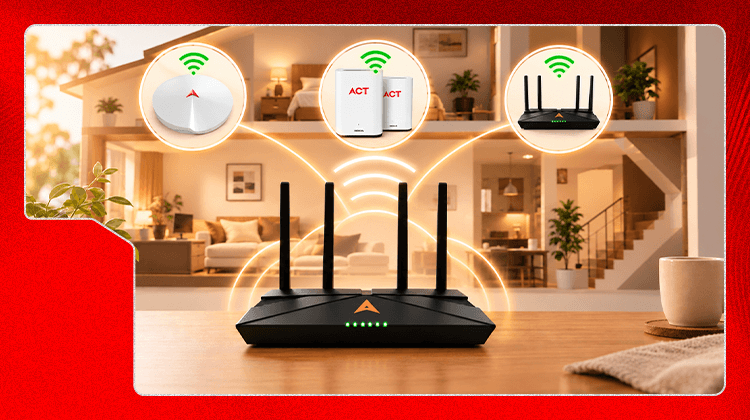
If you've already diagnosed a genuine coverage problem — a dead zone caused by distance or a concrete wall, not interference or placement — the next decision is which piece of hardware actually solves it. For most Indian homes, which are frequently multi-floor with concrete construction, the right answer depends less on budget and more on the layout of the home.
| Wifi extender | Mesh system | New / better router | |
| What it does | Repeats the existing signal further | Multiple units share one network, hand off devices between them | Improves range and speed from a single central point |
| Best for | One nearby dead zone, single floor | Multi-floor homes, concrete construction, several dead zones | Homes where the current router is old or underpowered, but layout isn't the issue |
| Setup effort | Low — plug in, connects to existing wifi | Moderate — units placed at multiple points | Low, but may need re-doing your split-band setup |
| Ongoing experience | Often creates a second network name, manual switching needed | Single network name, seamless handoff between units | No change in experience, just better range/speed |
| Typical cost | Lowest | Highest, but scales with home size | Mid, one-time |
Concrete floors and load-bearing walls are the main reason a single router — however good — often can't cover a duplex or a home spread across floors. In this specific layout, a mesh system with one unit per floor consistently outperforms a single stronger router or a single extender, because the problem is structural, not about router power.
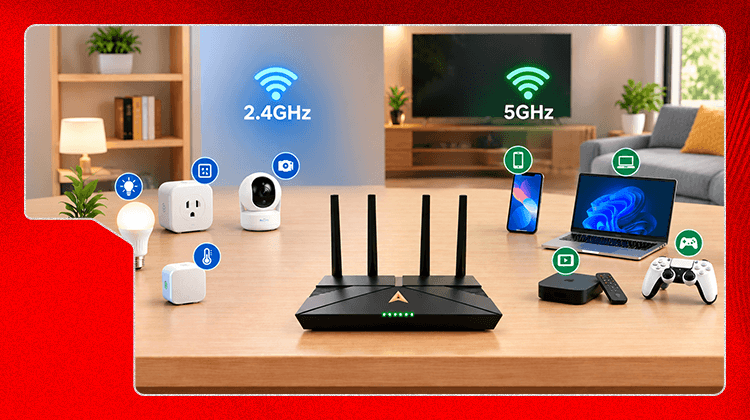
If it's one room, one floor, and the rest of the house is fine, an extender is usually enough and is the cheapest fix. The trade-off is that budget extenders create a separate network name you have to manually switch to, which reintroduces some of the same friction that band-splitting solves for 2.4GHz vs 5GHz — some newer extenders support seamless handoff, so check for that before buying.
If your router is more than 4 to 5 years old and coverage is poor even on a single floor with no major obstructions, a new dual-band router alone may resolve it without needing an extender or mesh at all — replacing hardware you'd otherwise be working around.
If you haven't diagnosed the cause of your dead zone yet, start with "Still Getting Wifi Dead Zones After Switching to Dual-Band? Here's Why." For the basics of how dual-band routers work, see our main guide (actcorp.in/blog/what-is-dual-band-wifi-router-its-benefits).

Lead has been submitted successfully.
 Please wait while we redirect you
One of our representatives will reach out to you shortly
One of our representatives will reach out to your shortly
Please wait while we redirect you

Please enter your registered phone number to proceed
Please enter correct OTP to proceed

Dear customer you are successfully subscribed
Please wait while we redirect you
Your ACT Shield subscription has been successfully deactivated
Please wait while we redirect you
Dear user, Your account doesn't have an active subscription
Please wait while we redirect you
Dear customer Entertainment pack is already activated.
Please wait while we redirect you